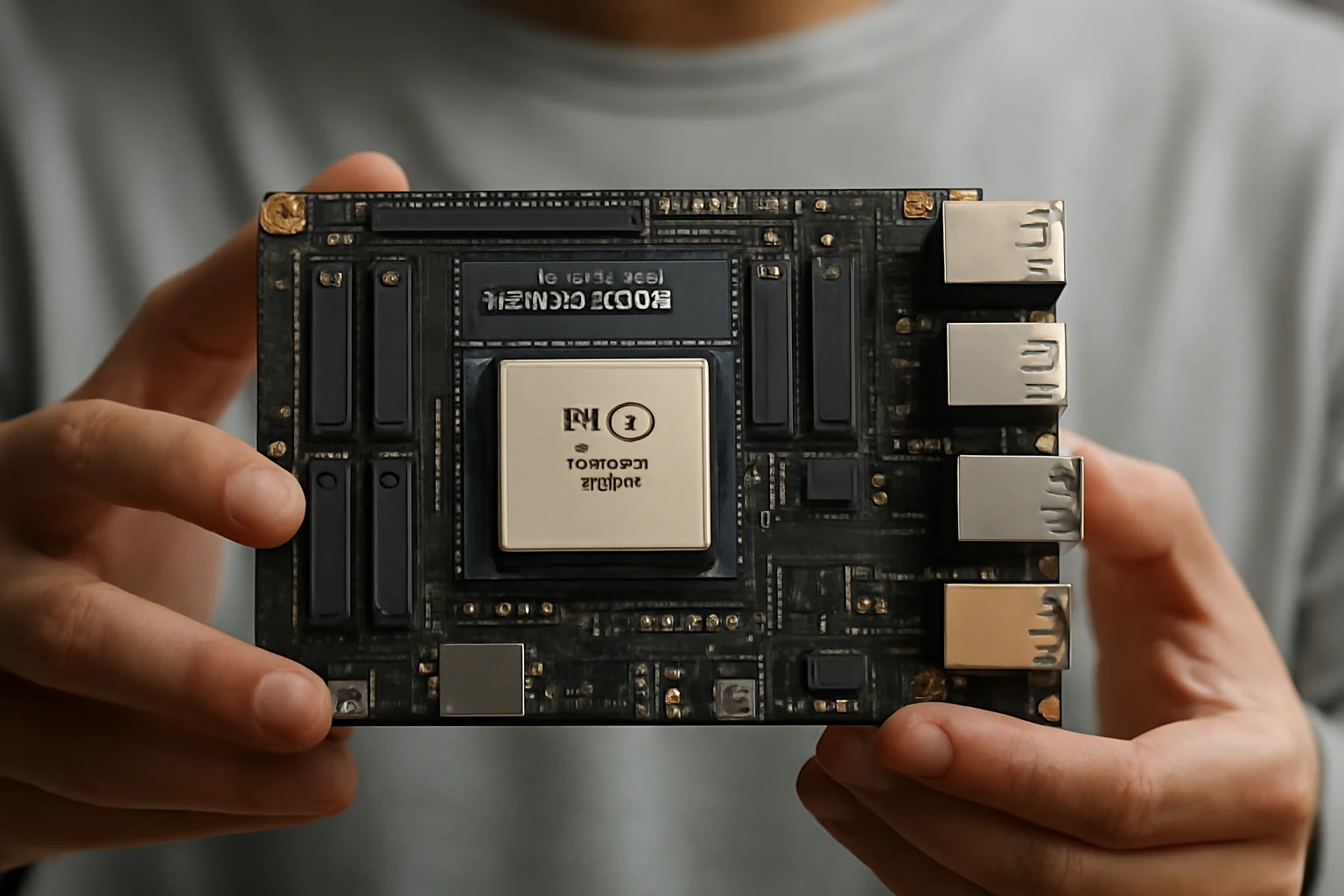
A board designed for local AI
The LattePanda team, a brand linked to DFRobot, has announced Sigma 2, a high-performance single-board computer. According to IT之家, the board is based on an Intel Core Ultra X7 358H processor and integrates 64GB of LPDDR5X-8533 memory soldered onto the board. The stated dimensions are 146×202 millimeters, and cooling is handled by a heatsink with a turbo fan.
The intended use indicated by the source is AI processing in edge and embedded environments. Among the cited scenarios are local AI services running continuously, private servers, home labs, NAS, industrial computing, computer vision and autonomous robotics. These are applications in which the board is expected to operate without depending on a remote data center, but the material does not report performance measurements that would make it possible to assess how sustainable these workloads actually are.
Connectivity and storage: the board opens up to expansion
The port complement is extensive and distributed across both sides of the board. On the front are two Thunderbolt 4 connectors, two 10Gbps USB-A ports, two 480Mbps USB-A ports, one OCuLink 2i port over PCIe Gen4, two 10GbE LAN ports, one HDMI 2.1 output, an RS-232/485 pin header and a 480Mbps USB header, as well as GPIO derived from an RP2350 microcontroller.
The rear houses four M.2 slots. One is reserved for a PCIe or CNVio3 wireless network card; the others expose PCIe Gen5 ×2, PCIe Gen4 ×4 and PCIe Gen4 ×1 connections, intended for SSDs or M.2-format accelerators. An eDP 1.5 interface and an I²C connection for touch panels complete the picture. The simultaneous presence of dual 10GbE, Thunderbolt 4 and PCIe Gen5 suggests use as a compute and storage node on a network, but the source does not indicate the aggregate bandwidth or the number of PCIe lanes actually available in each configuration.
Price and information still missing
The configuration with a 1TB SSD is offered for pre-order at $2,599, equivalent according to IT之家 to approximately 17,383 yuan at the indicated exchange rate. The figure concerns the pre-order, and it is unclear whether it is a promotional price or the final list price; neither the shipping date nor any availability in other markets is indicated.
Several elements relevant to a comparison also remain to be verified, such as the performance of the Core Ultra X7 358H under local AI workloads, the board's power consumption and cooling conditions, operating system compatibility and software support. The material is limited to announcing the product and its hardware features: assessments of its real capabilities require data that are not currently published.
