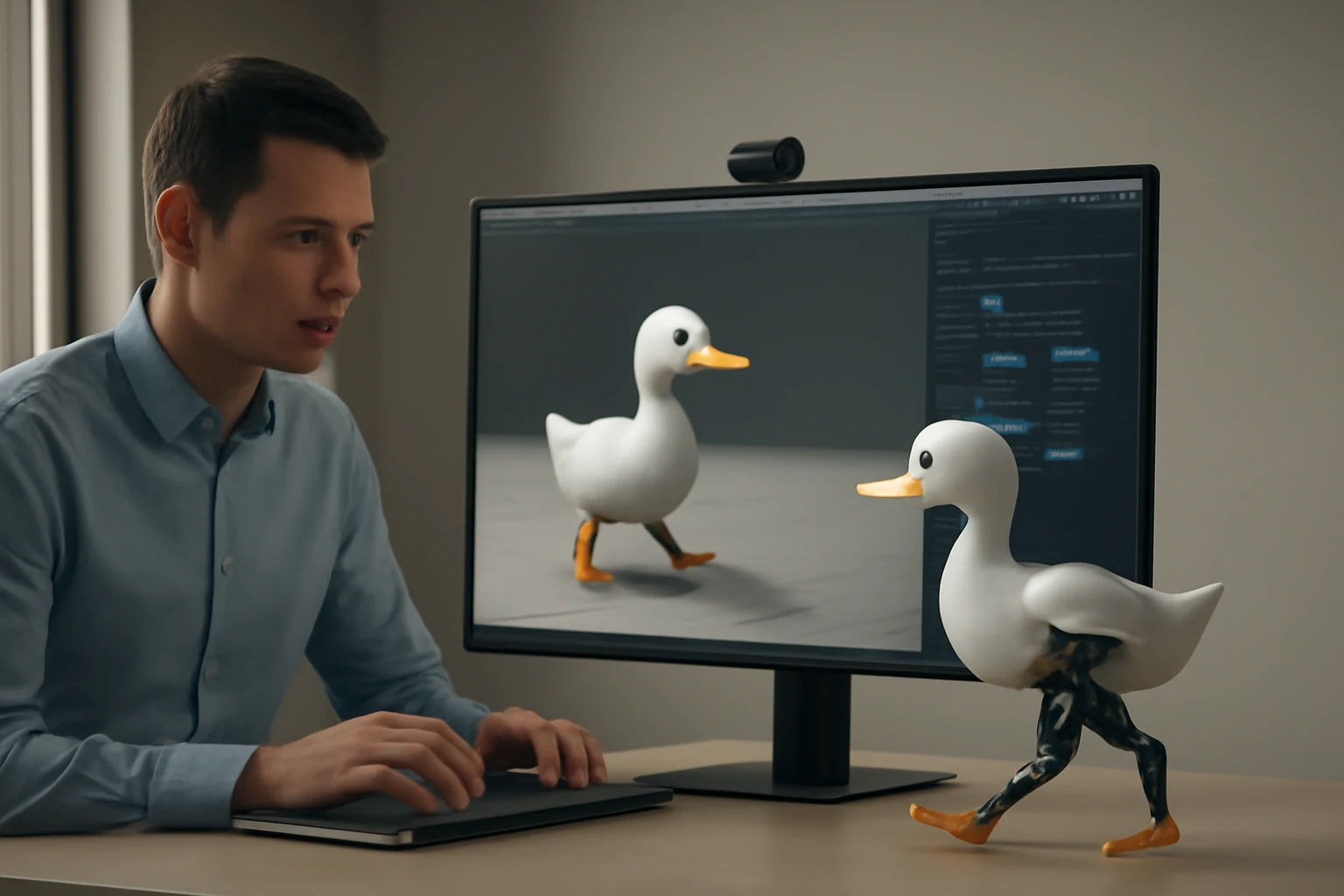
A bridge between simulation and hardware
Microduck, the open-source, low-cost bipedal robot presented by Pollen Robotics with Hugging Face, is now the focus of a tutorial illustrating its walking training via Isaac Lab, NVIDIA's open-source framework for training policies across thousands of simulations run in parallel on GPUs. The crucial step consists of transforming a policy trained in a simulated environment into a model capable of running on the physical robot, by exporting it in ONNX format and loading it onto the onboard runtime.
According to the source, the main challenge is that a walking policy trained in simulation must still handle friction, delays, and mechanical backlash of the real servos. For this reason, the workflow combines Newton with the MJWarp solver and BAM actuator models, which reproduce servo behavior by modeling the firmware controller, motor electrical limits, friction, and delay. To these is added domain randomization: mass and center of mass, ground friction, joint inertia, encoder offsets, voltage and battery drop, command latency, as well as external pushes and terrain variations.
Figures and steps in the tutorial
The material indicates that the policy receives 61 observation values and returns 14 joint positions, and that the observation order, normalization, and action scaling must remain consistent between export and deployment. A flat-terrain environment is cited, along with a rough variant with stairs, slopes, and uneven ground. The source also reports that, with rough terrain and active mechanical backlash, the configuration can reach up to 1.25 million steps per second and that training can be distributed across multiple GPUs, citing the example of 16 GPUs to increase speed and robustness.
Isaac Lab's RSL-RL export flow automatically produces both a TorchScript file and an ONNX file: it is the latter that the robot's onboard runtime loads. The tutorial then describes sharing the model on the Hugging Face Hub, with the recommendation to add a model card and the training configuration to support reproducibility, and verification in Microduck Arena, a Hugging Face Space that accepts models with 61 observations, 14 actions, and a maximum size of 64 MiB.
What is confirmed and what remains to be verified
The source states that the physical robot, after deployment of the policy, shows recovery capabilities: a case is shown in which Microduck, after being hit, regains its balance and resumes walking. The material also describes possible extensions, such as adding a front camera for perception and navigation tasks, manipulation with Kuka-Allegro examples, and the creation of custom environments.
However, some elements useful for an independent assessment remain outside the material: training times, hardware or energy costs, measured success rates, and comparative results on the Microduck Arena leaderboard are not indicated. The performance figures cited should therefore be attributed to the source and regarded as descriptive of a tutorial, not as external validation. Based on the available information, the value of the initiative lies above all in providing a reproducible and accessible path for taking a locomotion policy from simulation to the robot.
