The cluster doubles
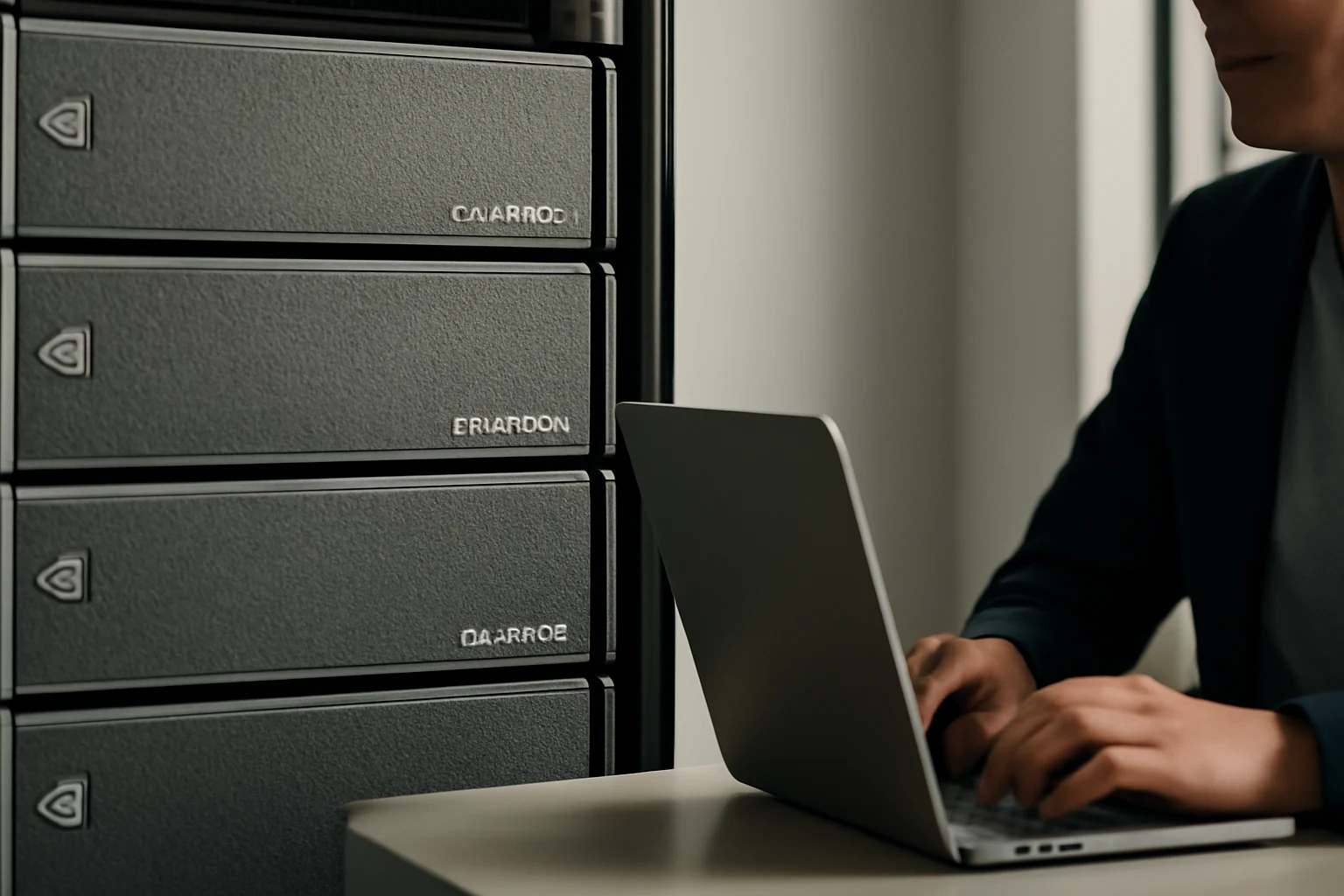
Nvidia announced at GTC 2026 in Berlin that DGX Spark goes from a maximum of four to a maximum of eight units that can be manually configured in a cluster. According to the company, a configuration with 128GB versions can reach up to 1TB of total unified memory. The news is significant because it shifts the product toward local inference scenarios on larger models, which require more memory than a single node offers.
The 64GB version of DGX Spark, priced at $4,999, will be distributed by partners starting October 23. For cluster deployment, Nvidia plans to launch Sync Model Launcher by the end of the month, a tool that downloads models and containers suited to the hardware configuration, connects them to OpenCode and automatically loads DGX Spark Skills for maintenance and troubleshooting assistance.
The October software update also introduces a Wi-Fi assistant to change networks in appliance mode and integrates DGX Spark Skills into Nvidia Sync via OpenCode. These are routine management functions, but they are consistent with the device's use as a desktop AI machine entrusted to teams and not only to individual developers.
Models and optimizations
On the models front, Nvidia claims local support for Nemotron, GLM, DeepSeek, Qwen, MiniMax and FLUX.3 Klein, for agentic, coding, generation and image-editing tasks. The company also introduces Recursive Flint, a coding model with a mixture-of-experts architecture with 40 billion total parameters and 2.5 billion active, which according to Nvidia exceeds 220 tokens per second in inference on RTX Spark with 64GB of memory.
To reduce memory pressure, Nvidia releases quantized checkpoints that it claims are close to the accuracy of full-precision models: Qwen3.8-Flash-Next-FP4-Local is intended for a single 128GB DGX Spark or for RTX PRO 6000, while GLM-5.3-Flash-FP4-Local requires two systems.
The optimizations also involve the llama.cpp and vLLM communities. Nvidia claims that, with multi-token speculative decoding on Qwen 3.8 Flash Next, RTX PRO 6000 Blackwell gains up to 1.4x in end-to-end agentic tasks; on vLLM, with speculative decoding and FlashInfer prefill kernels on Qwen3.8 27B, DGX Spark gains up to 1.3x; DGX Station with GLM 5.3 Flash reaches 1.2x its previous throughput. In summary, the company claims increases of up to 40% on RTX PRO 6000 Blackwell and up to 30% and 20%, respectively, on DGX Spark and DGX Station. These figures are manufacturer claims, not independent verifications.
Ecosystem and timing
Nvidia announces seven enterprise management integrations for DGX Station, including Absolute Security, Splunk from Cisco, Microsoft Intune and Tanium, intended for the deployment and management of local AI infrastructure. A Windows version of DGX Station is expected in December, with applications for production and workflows for design, simulation, validation and engineering automation. An open-source robotics workflow is also planned and, in early access, Nvidia Cloud Functions for sharing local model services through a single interface.
Performance gains in real-world scenarios, the actual availability of eight-node clusters and the operation of Sync Model Launcher, announced but not yet released, remain to be verified. The picture that emerges is that of an ecosystem Nvidia is building around local inference, from memory to management to optimized models.
