A different use of the same transformer
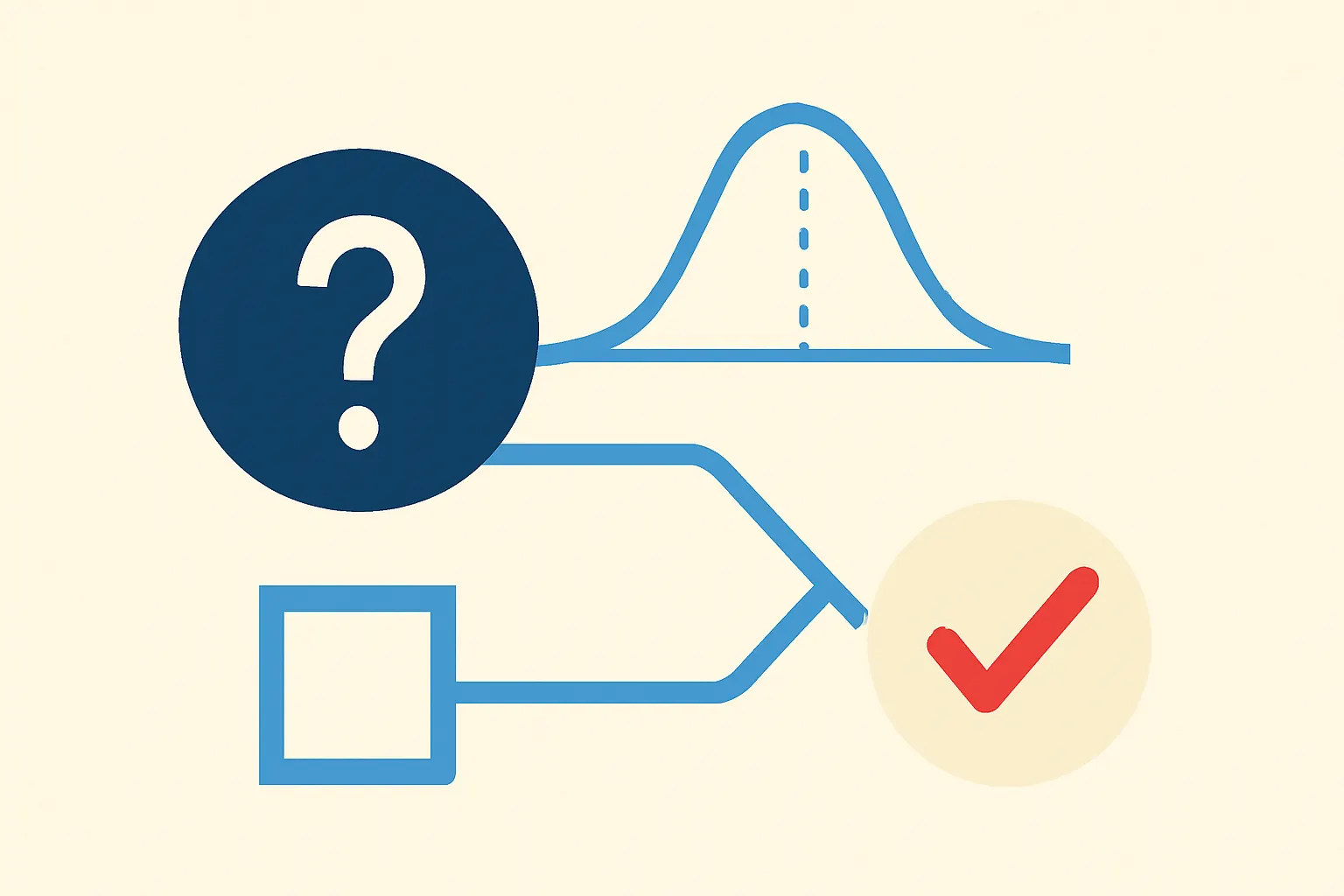
According to the guide published by AI4Business, a decision model is a transformer network designed to answer closed-ended questions by assigning a probability to the possible answers, without producing text. The network is given content and a list of questions with the permitted answers; the output is, for each question, a probability distribution over the available options. An algorithm then uses those values to decide or trigger actions.
The difference from a generative LLM lies in the mechanism: the language model chooses one token at a time by sampling from a distribution and feeding the result back into the input, whereas the decision model reads the input only once and directly derives the probability of each permitted answer. The result is a typed value, not text to be interpreted. The source also notes a limitation: the model does not justify the choice, so a different tool is needed to provide an explanation to customers or auditors.
Three primitives and the role of thresholds
All decision models released so far, commercial and open, share three primitives, whose names used by TypeSafe have become de facto standards: Noul for yes/no, Choice for choosing among multiple options, and Score for position on a scale. Each question has an identifier chosen by the developer, a type, instructions in natural language and, for Choice and Score, criteria defining the permitted answers.
In the Noul type, the answer is a value between 0 and 1, the probability of a yes; the code applies thresholds to determine how to behave. With Choice, a selection is made from a closed, unordered set, with a confidence value indicating how concentrated the probability is on a single option. With Score, a probability is assigned to ordered levels, and the final score is the weighted average of the numerical values associated with them. The guide recommends precise questions and well-defined levels, because generic descriptions are ineffective.
Differences from classifiers and structured output
Compared with traditional classifiers, used for decades to sort emails or flag fraud, the decision model does not require hundreds or thousands of labeled examples or new training when categories change: categories are described in words at request time. The downside, according to the source, is that a classifier trained on proprietary data in a narrow and stable domain can achieve higher accuracy with near-zero inference costs.
The guide also distinguishes the decision model from pipelines that use an LLM in structured-output mode: in that case the decision must be formulated via a prompt, the response must be extracted from the text, and the probability, when available, cannot be used to set thresholds. The tests cited nonetheless indicate that frontier generative models remain more accurate in complex judgments requiring multi-step reasoning.
Among the temporal references, the source cites Jev by TypeSafe AI, released in early access on September 15, 2026 and presented as a System One model, and the appearance within a few weeks of open-source models with the same interface and support in libraries such as LangChain4j's DecisionModel API. The reliability of calibrated probabilities in different domains and the actual weight of thresholds in automated decisions remain to be verified in the field.
