The discovery and the system's numbers
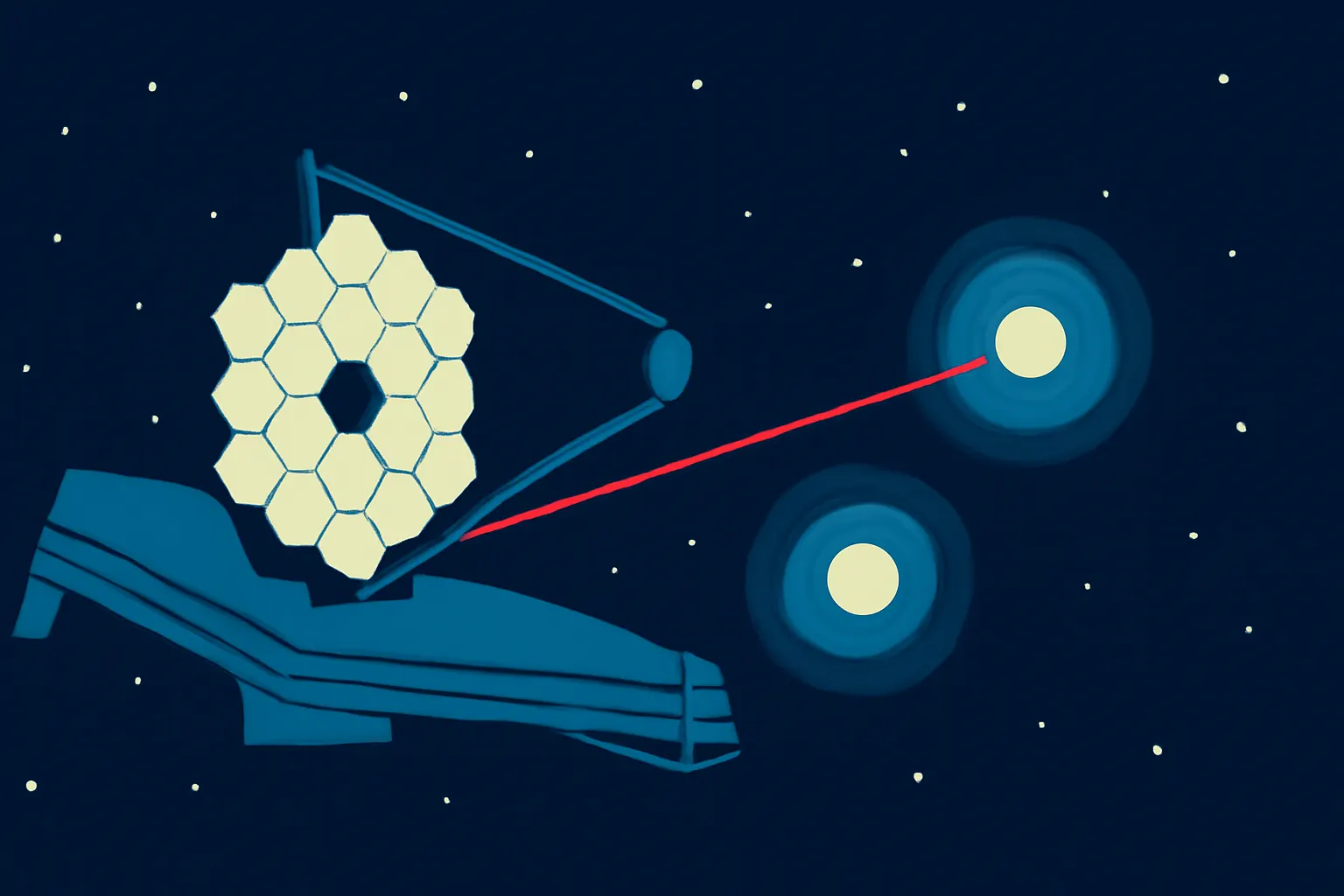
A group of astronomers has identified, thanks to the James Webb Space Telescope, the oldest pair of quasars observed so far, according to IT之家. The two objects, cataloged as J1602+4228AB and nicknamed Nāpōwawāʻenakaulua, were confirmed with the Gemini North telescope. The light reaching us shows the system as it was about 900 million years after the Big Bang.
The masses of the two supermassive black holes are estimated at about 1.5 billion and 400 million times that of the Sun, while their mutual distance is about 18,100 light-years, equal to one-fifth of the diameter of the Milky Way. According to the source, this is the closest pair of quasars ever observed in the era called the "cosmic dawn," the phase in which the first stars, galaxies and black holes appeared.
Why it challenges growth models
According to current models, a black hole takes at least a billion years, accumulating matter and merging with other black holes, to reach masses of millions or billions of times that of the Sun. The discovered system, however, already existed before that time threshold and hosts two objects of sizes comparable to those observed today, as stated by Silvia Onorato of NOIRLab, head of the research team.
The researcher said that at present there is no theory capable of explaining the presence of such a giant so early, let alone two. IT之家 recalls that the Webb telescope, operational since 2022, has already identified other quasars dating back to about 400 million years after the Big Bang, and that this is the third pair of quasars discovered in the cosmic dawn.
How it was found and what remains to be understood
The pair emerged from data from Webb's Aether survey project; thanks to the NIRSpec infrared spectrograph, the researchers cataloged about 200 quasars, just under half of all those known in the primordial universe. The second component was noticed next to J1602+4228A and resolved with Gemini North thanks to favorable atmospheric conditions on Maunakea, Hawaii.
The authors published the results on November 10 in the journal The Astrophysical Journal Letters. The system's formation mechanism remains unknown: the source specifies, however, that the study could help understand how, in the primordial universe, the first large galaxies and their central black holes aggregated through direct interactions. No independent confirmations or verified alternative explanations are available.
