The crash and the day's numbers
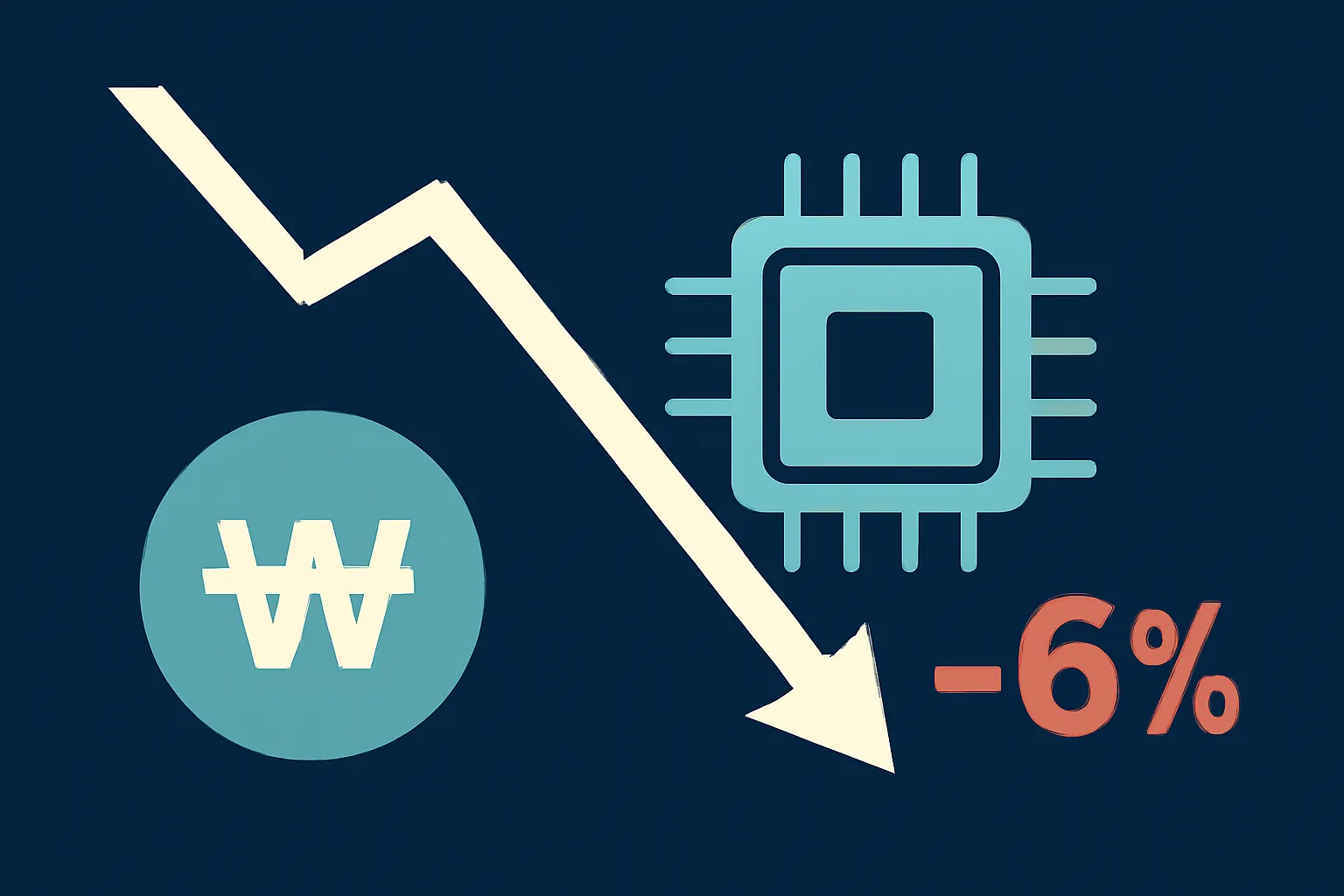
The Seoul stock market experienced a session of heavy selling on Friday: according to the Korea Herald, the Kospi closed at 5,059.69 points, down 6.02 percent from the previous session. Shortly after the open, the index had plunged 8.78 percent to an intraday low of 4,911.28 points, falling below 5,000 for the first time since the beginning of February. The move triggered the circuit breaker and the sell-sidecar in quick succession, before a partial recovery.
According to the Korea Exchange, foreign investors were net sellers of 2.77 trillion won, while retail and institutional investors bought 601 billion and 1.70 trillion won, respectively. The Kosdaq technology segment lost 5.03 percent, closing at 644.27 points, with a sell-sidecar activated at 9:06. On the currency market, the won weakened by 14.5 won to 1,356.6 per dollar at 15:30, its weakest level since May 12.
Samsung and SK hynix under pressure
Selling was concentrated in the large semiconductor manufacturers. Samsung Electronics closed at 188,700 won, down 6.35 percent, after falling to 179,200 won in the morning: the stock had not traded in the 170,000-won range since April 2, and has lost about half its value from its annual peak of 374,500 won. SK hynix fell 10.44 percent, closing at 1.132 million won, with an intraday low of 1.089 million won that took it below 1.1 million won for the first time since April 14; the day's low is equivalent to about one-third of its annual peak of 2.987 million won.
The pressure comes from the United States, according to the newspaper: on Wall Street, selling in AI- and semiconductor-related stocks triggered a wave that spread to global technology markets and to the Korean one. The Kospi could not escape the effects even though it had already fallen 5.28 percent the previous day. The cited trigger is fears of a tightening of rules on AI data center construction in the United States after the midterm elections, fears that, according to the account, had already been partly priced in by the market.
The context and analysts' caution
The correction is significant when compared with the year's performance: the Kospi had closed 2025 at 4,214.17 points, had risen to a high of 9,114.55 on June 22, and now stands at around 55 percent of that peak, effectively making obsolete the bullish forecasts that, a few months ago, pointed to a break above 10,000.
The analysts cited by the newspaper, however, consider concerns about the new rules disproportionate. Lee Jun-young of Eugene Investment & Securities judges both the fear of a sharp drop in AI investment and the fear of a severe slowdown in the US economy to be excessive. Lee Kyung-min of Daishin Securities considers a total halt in data center construction unlikely and estimates at 15-30 percent the probability of suspension of new projects in Texas, Georgia and Ohio, with more realistic risks tied to rising costs and construction delays. It remains to be seen, going forward, whether American regulatory guidance will confirm or scale back these fears.
