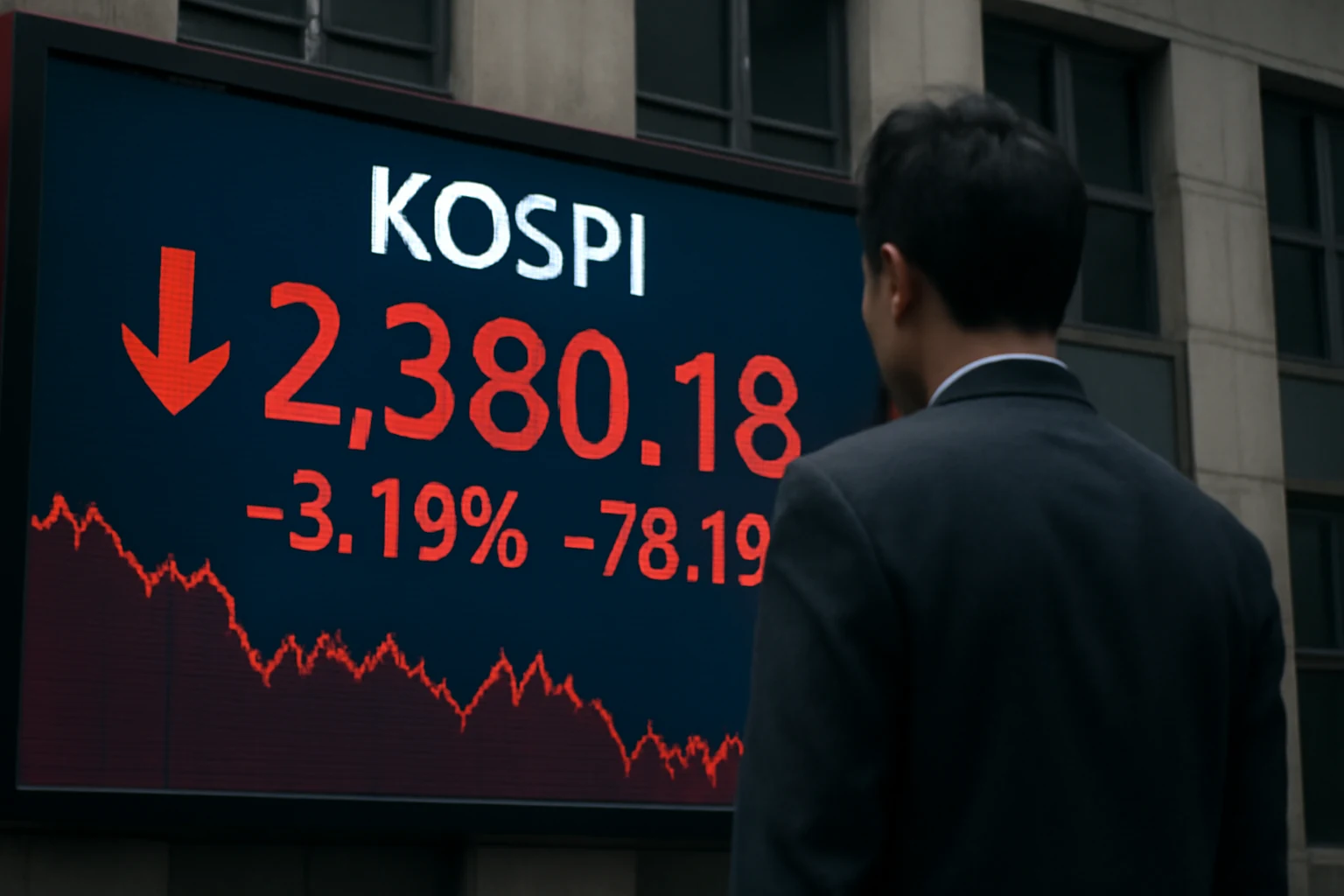
The decline at the open
The South Korean stock market began Friday's session sharply lower, according to The Korea Herald, weighed down by overnight losses in US AI and semiconductor stocks and by the simultaneous rise in oil prices. After opening down 2.36%, at 9:15 the Kospi, Seoul's main benchmark index, was down 156.6 points, or 2.83%, at 5,377.17.
The international picture before the Korean session was mixed: the Dow Jones closed up 0.02%, while the S&P 500 lost 1.21% and the technology-heavy Nasdaq Composite fell 2.6%. Among individual stocks, Micron Technology fell 6.26%, Nvidia 4.4% and Intel 8.04%, confirming the pressure concentrated on the semiconductor sector.
The knock-on effects on Korean stocks
Seoul's move therefore reflects a spillover effect from US markets: among benchmark stocks, Samsung Electronics, seen as a market barometer, lost 3.26%, while chip-sector rival SK hynix fell 2.21%. Battery maker LG Energy Solution also declined, down 2.56%, as did Samsung Electro-Mechanics, Samsung Electronics' electronic components affiliate, which recorded a 6.64% drop.
On the currency market, according to the cited data, the Korean won stood at 1,325.8 per dollar at 9:15, slightly strengthening by 0.7 won from the previous session's close. The figure, referring to a single morning reading, describes a market phase still under way rather than a consolidated trend for the day.
Oil and SK hynix's move
Added to the technology tensions is the energy factor: according to the report, oil prices rose on fears of supply disruptions after Yemen's Iran-aligned Houthi rebels said they had again struck key facilities in Saudi Arabia. This is a statement by the rebels, as reported by the source, not a fact independently verified in the available material.
On the same day, SK hynix announced that it had decided to suspend plans to list its US subsidiary Solidigm, citing market conditions. The information is a company statement and should be read as such: the material does not specify the original timetable for the operation, the value of any placement or the financial impact of the decision. The combination of the two elements — a sharply falling index and the abandonment of a placement — suggests a context of greater caution in the capital market, but the direct causal link is not asserted by the source and remains to be verified.
